Saturday, March 2, 2019

Nausicaa of the Valley of the Wind


      The first volume of this story was a pretty nice journey into what Nausicaa, as a character, is going to be for the rest of the series. There was a decent amount of development that Nausicaa, and even her mentor (?) Yupa went through as they were discovering the influence that Nausicaa can have on the world. Her fearlessness and drive to lead her people, from warding off the soldiers sent by the emperor to dealing with the Ohmu's, felt like a great highlight in that Nausicaa is a force to be reckoned with, although Yupa states that she has a power that is meant to heal. I personally have a little bit of a soft spot for stories that deal with coming to peaceful resolution - but violent resolution is a good way to go too, narratively - so it was easy to take a liking to Nausicaa and the people that she stood for. 

     I also found myself wondering what the hell is going on with the forest - I know that the Yupa mentions that, after seeing Nausicaa's secret spore lair, the forest is meant to cleanse the planet. From what I was able to gather, the insects of the forest are to help speed along that process - there's quote that says something along the lines of, humans are the reason for the heavy pollution. The dynamic established between the forest and the insects that reside within it made wish that there was more Ohmu speak going on. The fact that their thoughts go beyond space and time and allow them to communicate their thoughts/feelings to people is a really fun trait for creatures to have - the first thing I thought of when it was revealed that the Ohmu can speak, more or less, were Jabun and  Valoo from the Legend of Zelda the Wind Waker. They are a giant fish and dragon, respectively, that speak an old language that manifest as low-pitched resonating hums. They feel powerful - they feel like characters that have knowledge that we don't know and may never be told (up front) - and the Ohmu elicited similar feelings especially near the end when one of them says that "They are needed elsewhere." 

     The setting that Nausicaa was able to establish in the first volume alone was one that is much larger than man itself - a world who's traits are almost too large to imagine in its entirety. We get to just see pieces of it and I think that left a lasting impression on me. 10/10 will continue reading.

Sunday, February 17, 2019

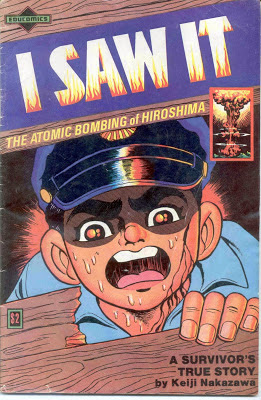
I SAW IT by Keiji Nakazawa + DISASTER DRAWN by Hillary Schrute - It's a Bad Time in War Time

https://blogger.googleusercontent.com/img/b/R29vZ2xl/AVvXsEhn1utfCRJNk37jLEjA7oBjeTB8yiCgGeL7SaMG0OQjmH8lWEUlkTzZk7KR0QjNJTPNFStbI_MNYA5IKxT6G-r8lviRIhtAXA04wz8I_1d6fdV9Bzb5FOVtYolyV-8JK13ngS39OQocULh1/s1600/ISawIt01.jpg 

 Hillary Schrute's analysis of Keiji Nakazawa's I saw it in her paper Disaster Drawn describes Nakazawa's experience with the atomic bomb of Hiroshima during World War II and explains what emotions he was attempting to evoke through his work. Before having read the story myself, the intended emotion of the story being told felt to still seep through Schrute's paper. I remember reading the portion of her story where she explains that Nakazawa was at school when the bomb dropped - and that he survived only because a wall he was standing by outside had collapsed upon him. After regaining consciousness, the city he once knew had transformed. Akin to waking up in a nightmare, Nakazawa having been greeted by what was left of the people of Hiroshima become monstrous. It's difficult to imagine what living a reality like that would be, but even then simply reading just Schrute's account of the manga was still effective. 

Many people would be afraid or disgusted of this work, if explained in concept and even moreso while reading it but that is what makes Nakazawa's piece powerful - because despite the horror, it is real. Schrute managed to stage the story and capture the main beats of the narrative, but reading the manga itself delivered a much more raw impact that I could not have gotten from Schrute's analysis alone. With its graphic depictions and even just seeing what it was that Nakazawa thought, it's easy to understand how this comic gained such merit and success. 

In the manga itself, Nakazawa explains that when he went to retrieve the bones of his parents that the bomb had even taken those away from him. It wasn't until then that the effects of him having lost his mother and father really begin to settle in - they were taken and they are gone forever. In a lot of popular media, a character can witness an event and will often react with great emotion immediately, yet Nakazawa's delayed understanding of the situation felt much more powerful than many other death scenes what I've seen in many of the movies I've watched and I think that's because we live as well. We suffer shock in greatly traumatizing events and the pain doesn't settle in until later.


Cigarette Girl by Masahiko Matsumoto - The Stresses of Marriage

To start, I thought the artistic style of Cigarette girl was weird - weird, yet it felt perfect for the type of characters that are seen in the story. The way every character's lips are sticking out of their silhouette reminds me of the dreaded 'duck face' trend that graced the internet for some period of time a while ago. It was a selfie-phenomenon where people would, for some reason, poke their lips out (I assume to look like they are blowing a kiss of some kind to look attractive). These people were flamed on the internet for looking so silly and I myself also thought it was a weird wave of how people took pictures of themselves - annoying almost - but these 'duck faces' placed in the context of just the art style of Cigarette Girl placed a lot more innocence and character on the story's universe. Even if the people weren't doing anything, it always looked like they were reacting to the world around them in some way (o3o).

With that said, following Hidari-san's story of trying to approach relationships was funny yet made me feel almost sympathetic for the character. Being that bum that he is while also not having being the smoothest of men meant he suffered a lot of awkward moments while trying to approach various women. One part that stuck out to me as especially funny was when he was told to squeeze the hand of his cigarette girl. He heeded this advice and squeezed her hand, after falling down the stairs and having her come to his aid. A frame of milk spilling followed a couple panels later by the greasy man who gave him the advice saying, "Didn't ya say you blew your load without actually doing anything?" was hysterical.

I know that marriage is, not unlike a lot of what seems to happen here, constantly pushed upon the upcoming generation once they become of age. A few of my friends have told me their parents are constantly bombarding them with "WHEN ARE YA GONNA COME HOME MARRIED? WHERE ARE MY GRANDCHILDREN?" This story was a more, I guess, realistic picture of what it's like to be in that situation - where the pressures of your parents nearly force you to find a significant other.


Thursday, February 7, 2019

The Gekiga Expert: A few questions

     Gekiga's influence is seen through a lot of manga and anime - both past and present. What manga(s) do you think set the groundwork for gekiga as we know it today?

     Are there any examples of manga that have become controversial - socially, politically, or whichever - and changed the medium altogether?

     Are there even more recent developments in Manga that have changed the way we experience manga (such as the art styles, panel layouts, story etc.)?


Wednesday, January 30, 2019

AYAKO | Reading Response


Image result for Ayako osamu tezuka cover


     Osamu Tezuka's AYAKO was a story of pure tragedy. I'd sit there thinking one person was at least decent and find out that they were quite the opposite. Following Tenge Jirou, I went into the story assuming that he was going to be the hero for his family after returning to them for so long. With a terrible father, who turned out to be a somehow more terrible human, the contrast in energy I felt from both of these people was strong enough that they seemed to fit into the niches of being the good and bad guy. But everyone is a bad guy in this film - with the most innocent being Ayako.

     Even from Jirou accepting his first task (first one revealed in the story) to discard a dead body on train tracks, I figured, 'Hey. Whoever he's dealing with must have done something bad, right? This can't be too common an occurrence." But ALAS, Jirou is FAMILIAR WITH MURDERING PEOPLE. Whoa. The bubbly man getting off of the ship has some secrets. And man, were those secrets DARK. On top of this all, his whole family is pretty much falling entirely apart - a group of incestuous, spiteful, and manipulative people. The only hope being Ayako, someone who is forced to be kept underneath the house as to not be revealed to all of these terrible truths. 

    AYAKO seems to be a story that details that no one can be innocent - no one can be entirely good. Every character had a terrible secret exposed at some point in the story, or were exposed to facts that shatter any hopeful glimmer of what life could be. Poor Ayako was left wandering the world looking for love, but still afraid of encountering what her family had put her through. I think it speaks to the fact that we are all human, but this story takes our emotions - love, lust, jealousy, anger - and turns the dial from 10 up to 100 and exposes what I think people are all to capable of in this real world that we live in. All of the issues in the story are extreme, so much so that a majority of it's readers will not have to experience these problems - but they hit close enough to him that they could be real. And considering much of human history, I'm certain that everything in this book was inspired by some real life events.

Project Proposal: COMEDY in ANIME

Image result for one punch man and mob
Mob and Saitama | Mob Psycho 100, One Punch Man respectively
      For my presentation, I'm think about approaching the topic of comedy in much more contemporary Shounen Anime. In particular, I will talk about Studio ONE's hits One Punch Man and Mob Psycho 100. Both of these Anime show their inspiration from the classic Shounen Anime formula, with battle hungry fighters and intense action sequences. With the skill cap in art constantly growing, One Punch Man and Mob Psycho 100 deliver very dynamic fights to their audiences. However, both of these shows also place great emphasis on comedy as well as action.

     Take the quirky moments in Dragon Ball Z where the Z Fighters get to catch a break and enjoy food or some other activity in between battles in a filler episode, and place those in One Punch Man / Mob Psycho 100 that give much more meaning and context to the characters. Comedy has been a relief from tension in entertainment for a while now and One Punch Man / Mob Psycho 100 give us this relief in ways that we can appreciate.

     This project would fit best in Week 11: Shounen and Seinen

Thursday, January 17, 2019

4 Panel Comic - That's not how legs work

That's not how legs work...
    
     My idea behind this comic was inspired by a fight that took place in the UFC some time ago where fighter Anderson Silva broke his own leg after attempting kicking his opponent's leg. In my short comic, I wanted the fight to look one-sided but the sudden break in the attacking fighter's leg changes the outcome of the match immediately.